Welcome
Welcome to the Araujo lab. Here we study the molecular mechanisms that regulate animal development. We would like to understand how each cell understands its position within the developing tissue, a fundamental aspect for defining cell differentiation and for the correct positioning of functional tissues and organs inside the animal. In addition to seeking to uncover how organisms develop and how their forms evolve, we use knowledge of the molecular bases of development to design biological control strategies for vectors of human disease.
News
Excellence in Gene Editing Research
During the week of September 3rd, we commemorated Biologist Day — a date that honors professionals committed to advancing knowledge about life in all its forms. In this context, we take great pride in congratulating Dr. Leonardo Lima de Faria, a former student of our laboratory, who recently completed his doctoral studies with pioneering research focused on gene editing in kissing bugs utilizing the CRISPR-Cas9 technology.
His work significantly advances the understanding of vectors responsible for Chagas disease, opening new avenues for the control of these insect populations through highly precise genetic approaches.
In addition to recognizing this noteworthy achievement, we extend our congratulations to all biologists, researchers, and enthusiasts of biology who follow and contribute directly or indirectly to our work. We also express our sincere gratitude to all members of the Araujo Lab team for making this space of scientific inquiry and innovation possible.
Scientific Entrepreneurship in Focus
It is with great pride that we highlight the career of Dr. Alison Henrique Ferreira Julio, who recently concluded his time at the Araujo Lab and currently serves as a FAPERJ Doctoral Entrepreneur.
As the founder of Fly2Human, a biotechnology startup focused on functional genetic tracking, Dr. Alison has established himself as one of the promising figures at the intersection of science and innovation.
Fly2Human has gained national recognition through its participation in prominent events such as Casa Firjan and this year’s edition of the Rio Innovation Week, reaffirming the transformative potential of biotechnology in Brazil. His trajectory reflects the entrepreneurial and visionary spirit we strive to foster at the Araujo Lab, connecting outstanding research with solutions that benefit society.
At the Genetics Congresses
From August 13 to 16, 2025, the 70th Brazilian Congress of Genetics will be held in Belém do Pará. Helena Marcolla Araujo, coordinator of the Developmental Molecular Biology Laboratory, will be attending on Thursday, August 14, 2025, from 3:30 PM to 5:00 PM, presenting the symposium entitled “The Mother Takes the Blame: First Steps in Insect Embryogenesis.”
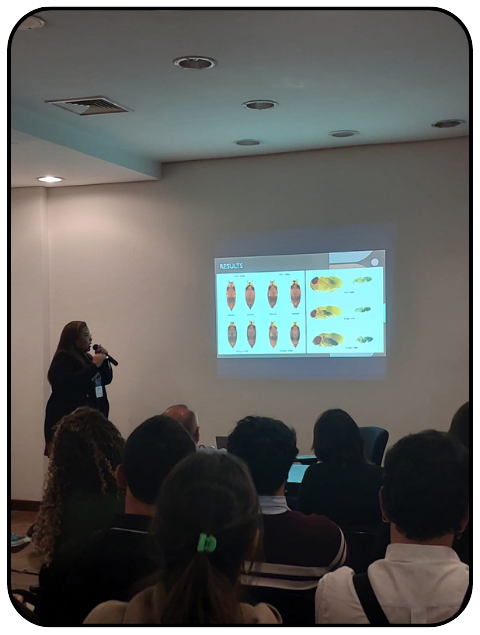
Our team participated in the 69th Brazilian Congress of Genetics that took place from August 20th to 23rd, 2024 in Campos do Jordão, São Paulo. During the event, Master Mariana Areal presented the work entitled “Molecular basis of pigmentation pattern in male wings of Drosophila suzukii,” and received the Paulo Sodero Martins award for the best work in the area of Evolutionary Genetics at the end of the event!
Gene Editing in a kissing bug
Check out our newest paper on the Cover of CRISPR Journal: “Gene Editing in the Chagas Disease Vector Rhodnius prolixus by Cas9- Mediated ReMOT Control”, showing for the first time CRISPR Gene Editing in a kissing bug.

Acess link: https://doi.org/10.1089/crispr.2023.0076
This same article was cited by the science dissemination page Gizmodo Brasil, on the UOL website. Here it is discussed how the article was made and what it is about, allowing for a better understanding of its development process and providing insight into the blog’s take on the topic at hand!

Acess Link: https://gizmodo.uol.com.br/cientistas-querem-usar-crispr-para-evitar-avanco-da-doenca-de-chagas/
Useful Links
Universidade Federal do Rio de Janeiro: https://ufrj.br/
Instituto de Ciências Biomédicas: https://icb.ccs.ufrj.br/
Programa de Pós-graduação em Ciências Morfológicas: https://ppgcm.icb.ufrj.br/
Instituto Nacional de Ciência e Tecnologia em Entomologia Molecular: https://www.inctem.bioqmed.ufrj.br/
Address
Laboratório de Biologia Molecular do Desenvolvimento – Centro de Ciências da Saúde (CCS), Bloco F, sala F2-031 – UFRJ – Cidade Universitária – Rio de Janeiro – RJ – Brasil ZIP 21941-902

 Araujo Lab